 Radio and jingles were closely knit together in Western Europa, here is a brief history about the first steps to come to commerial radio, reported by Jelle Boonstra.
 Radio in the post-war years was kind of cultural. Most countries had public radio, controlled by the governement. They used radio for education mainly.
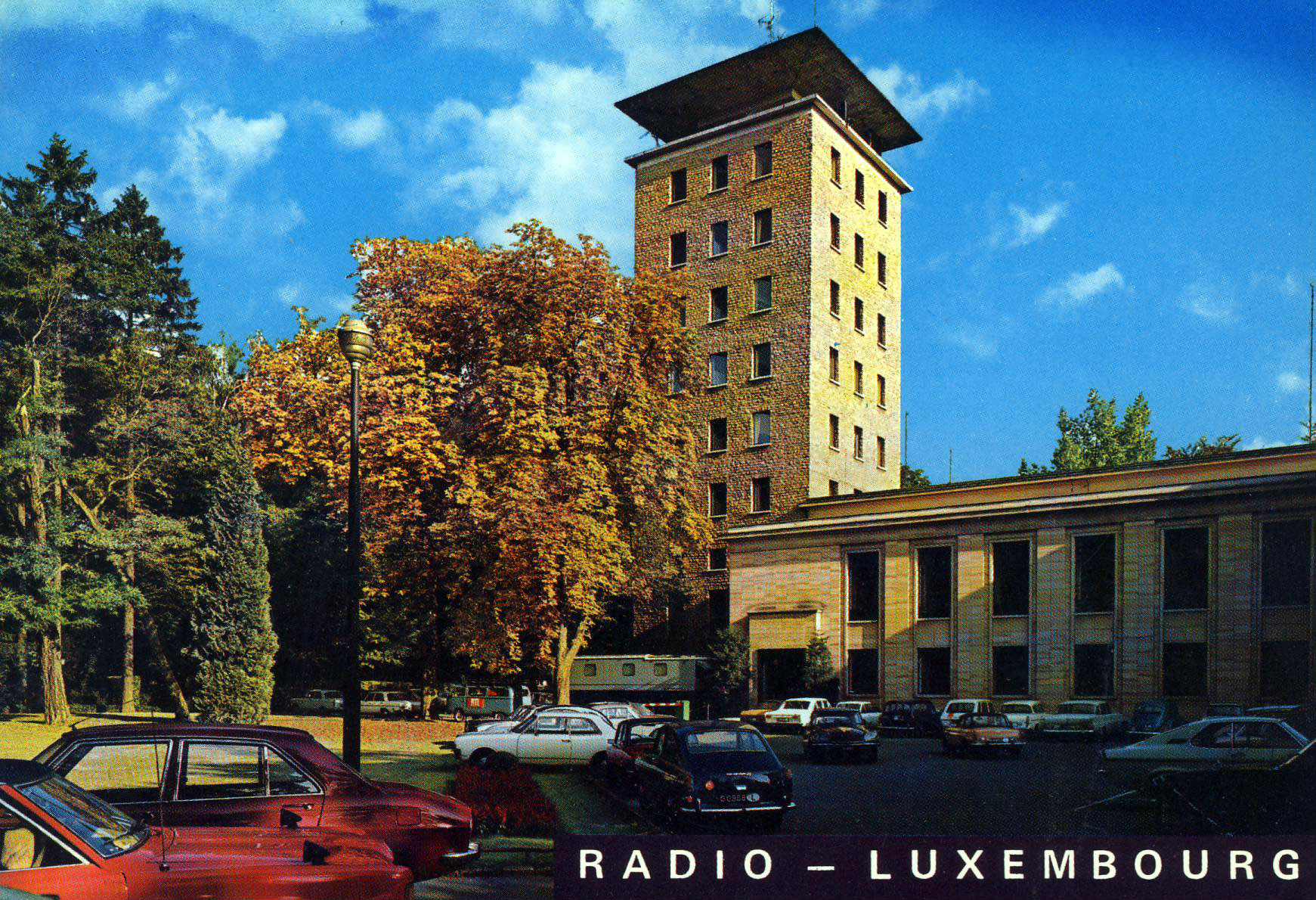
 The dwarf states in Europa made up for that, like Radio Luxemburg, a border blaster for the whole of Western Europe.
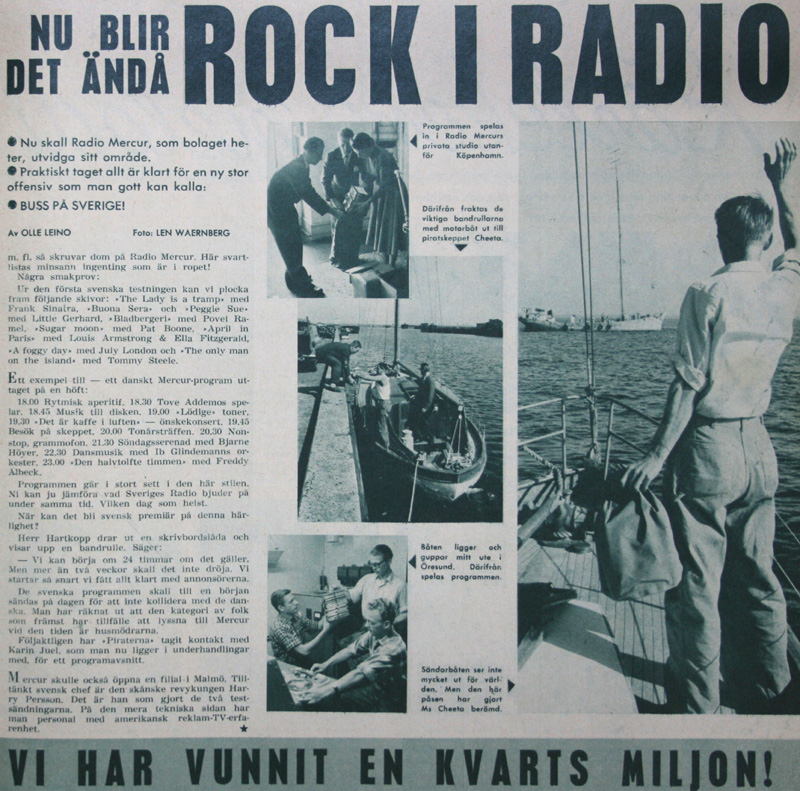
 In the 1950s commercial radio came from a boat. Outside the 3 mile limit at sea there was no radio legislation, Radio Mercur started it all in august 1958.
 This is how the ship was being tendered in the first few months: by plane.
 Which was fine on the calm summer days.
 Soon the’d got themselves a better (FM) aerial system.
 The gouvernement tried to silence them soon, to protect their public radio system, soon that was a Pavlov reaction in other countries.
 The US Army had shown the way how broadcasting from a boat was done, by transmitting programmes to the east block countries near Rhodes in Greece in 1951, using a balloon to support the antenna (an idea that Laser 558 picked up in 1983).
 With jazzmusician Ib Glindemann, composing the first offshore radio-ID, a fanfare on FM.
 This is how tiny the ship really was.
 Owner Britt Wadner became the well known pirate queen of Scandinavia.
 When she had to serve a jail sentence of a month for her pirate activities thousands of listeners showed their sympathy on the train station (march 1965)
 And the ships got better gradually – an old ferry ship was bought: the Cheetah II.
 Transformed in an offshore station.
 This is the ship during an overhaul in Vlissingen (The Netherlands).
 A nice ship indeed (as printed on their QSL card).
 The ship (purchased by Radio Syd later) eventually ended up in Banjul (Gambia, Africa). This great picture was published on the website ‘Scandinavian Offshore Radio’ recently and is restored for the occasion on this page.
 After the pirate radio laws Britt moved to Gambia in Africa and started the first commercial station in that country.
 The ship is still there, well – kind of – under water nowadays (at the left in the foreground).
 The ships in Scandinavia kept on coming, like this one: DCR, from an old Dutch coaster – find more about them here.
 In august 1962 the gouvernement decided to board the ship.
 And the people behind the venture all were prosecuted.
 Mercur inspired Radio Veronica in The Netherlands in 1960, their first theme tune: Ted Heath and His Music – Swingin’ Shepherd Blues.
All the Veronica photo’s on this page have moved to A HISTORY of VERONICA
 And soon new ships came along, like Radio Nord in Sweden (1961-1962).
 Sweden got it’s Radio Nord in 1961, a very professional set up
 They arived with state of the art equipment, from 1961, the best in the business.
 Gordon McLendon, of the ever innovating Top 40 station KLIF 1190 in Dallas,was one of the owners.
 With posh new studios in the heart of Stockholm, here with DJ Gert Landin.
 Jingles were made by the Henry Fox Orkester, at the piano in this 1934 photo: Henrie Fuchs (a.k.a. Fox)
 And sung by the (Finnish)Harmony sisters, stars of the day, back then in 1961.
 They oftened supplied the ship from a plane.
 As they proudly boasted on their 1961 QSL card.
 Sailing the high seas.
 The former offices at Kammakargatan 46 in Stockholm nowadays are a youth hotel now, get the Radio Nord feeling, and stay within every budget at the same time.
 After the closedown the ship sailed to Belgium.
 It was renamed the Magda Maria on their way.
 And here’s the ship on november 11th in 1962, taken from the city archives in Oostend.
 After that they sailed it to Galveston in Texas, stay tuned, there is more to come from this .mystery ship”, now called the Mi Amigo.
  Belgium had it’s own station too, Radio Antwerpen, from ship called the Uilenspiegel.
 They had a fitting station-ID: ‘Till Eulenspiegels lustige Streiche‘, by Richard Strauss.
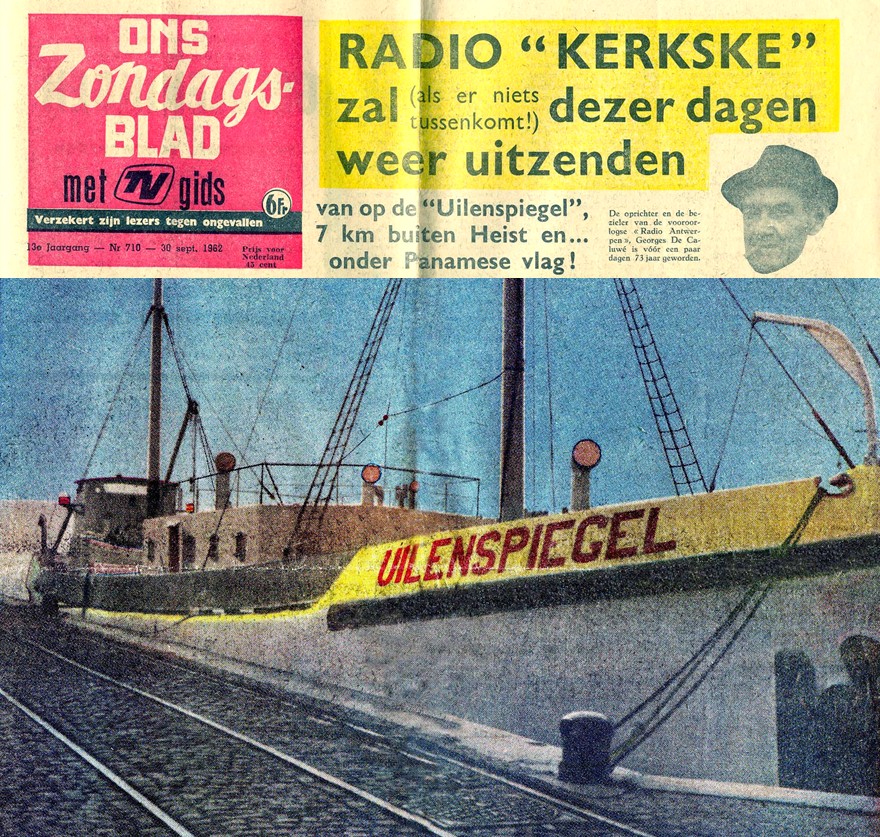
 Thew ship had been fitted out in Antwerpen.
 And was owned by Georges de Caluwé.
 The ship was of concrete and was built in France, in the first world war.

This is the original map of the ship.
 The studio was ashore in Hove, just outside Antwerp in Belgium.
 After two months they were washed ashore.
 And stayed on the beach for years
 And years….
 and years….
 Until the ship was finally removed.
 At Easter 1964 Radio Caroline caused a pop revolution in Great Britain.
 The jingles were done by organplayer Jimmy McGriff an singer Madeline Bell – this is their complete tape, includes rejected jingles.
 And again there was a Dallas connection, Continental Electronics gave them a voice of 10.000 watts.
 And later, they just boasted their customer floating around the British isles.
 The same month another ship arrived, newswire ANP had this photo taken in Falmouth, hey, and there it is again: the Mi Amigo.
 Here on another fuzzy newspaper wire photo.
 In full swing here, with maintenance in the aerial.
 The North ship was an ex-ferry boat from the Baltic, plenty of room.
 It was the Fredericia.
 Here’s the ship during the first month of operations.
 DJ Simon Dee gaining instant popularity.
  It’s him on the deck of the Fredericia.
 The boss of it all was the young Irishman Ronan O’Rahilly.
  Moored it the rough Irish sea – near Liverpool & Manchester.
 Here’s on of the most famous North-dj’s: Tony Prince.
 Holland even got an offshore TV-station from a special designed platform: the REM-island. Proposed heme tune: ZZ& The Maskers and Northsea Melody.
 This was how the station was build.
 The parts where hoisted by a giant ship, the Global Adventurer.
 And the mast was erected on the high seas.
 Reaching 110 metes above sea level.
  This was their studio in august 1964, when the first picture was transmitted.
 Yes, this one!
 Quickly building an audience in the matter of weeks.
 By broadcasting the American TV hits of the day.
 The studio wasn’t quite ready though.
 They’d pickel all there state of the art equipent from the 1963 RCA TV catal0gue.
 Like this TV transmitter (photo was taken from the RCA Broadcasting Magazine) .

THis was theire 1000 watts radio transmitter (later to be used by Radio Atlantis). Taken by force four months later: the gouvernement decided to send in the marines.
 The press was awaiting the raid on december 17th 1964.
 REM in the early daylight of that december morning
 They occupied the proud platform in december 1964.
 It remained at sea as an official beacon, ’till it was finally removed in 2006.
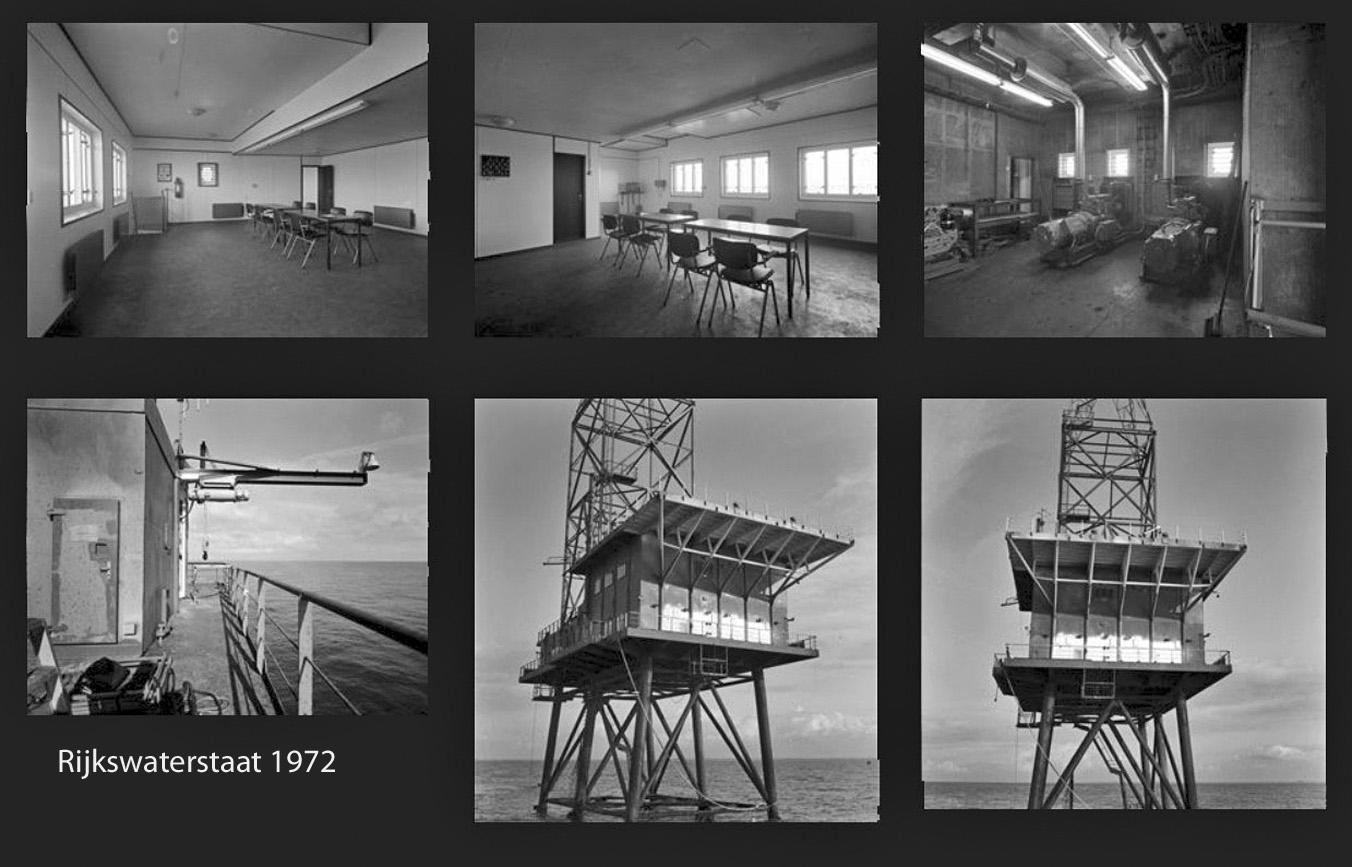
 The society’s Jelle Boonstra and one of rhe tv antennas that laid waste for years – here photographed in 1977.
 Veronica got itself a new ship in ’64, secretly fitted out in Zaandam.

The first QSL card of the new ship (still no name painted on it)
 And then along came Radio London, bringing jingles of the legendary PAMS of Dallas to Europe for the first time with ‘The Sonowaltz’ as a kind of stations’ anthem.
 Here’s the ship on the day after their arrival in december 1964.
 Let’s say it rather had some similarities with a jazz-hit in 1961 by Slide Hampton.
 They used PAMS # 17 (New Frontier) and # 18 Sonosational, box & tape schedule were published in a double CD and a Radio London book by East Anglian Productions.
 The Sonowaltz was written by staff-writer Euel Box, who had himself an Oscar-nomination in 1974 for the Benji-soundtrack. (Euel Box photo thanks to www.pams.com).
 The DJ’s, like Tony Windsor became incredibly popular.
 They got themselves a RCA cart system.
 The ship (painted green before the closedown) during the final days, august 1967.
 The ship moved to Hamburg, photographed by Thomas Krüger in 1973.
 When you go to Rome, have a drink a Radio Londra, a rather odd place, not named after the ship but after the war-time Itlian service of de BBC from London. Still.
 Soon followed by Swinging Radio England & Britain radio.
 Texas was quite important for offshore stations. The state supplied backers of the Radios Nord, London, England & Britain – and Continental Electronics in Houston give lots of them a voice: a strong transmitter.
 And many, like Britain radio & Radio England got their jingles from PAMS in Dallas.
 They ontained an old warship too.
 And they had a mix of American and English jocks.
 Patiently posing.
  They used one of the Liberty ships from WWII (the film ‘Dogs of war’ is starring one).
 We need to show you this one: where as Radio England was build as a broadcast station, the navy built a listening station, for intelligence in the cold war days.
 Although the stations are long gone, the hardware is still there, this is the ship in 2008.
 Yet another one on it’s way – Radio Scotland.
 Als based on a lightship that was laid to rest – the Daunt Rock, here in the old days.
 After the close down the aerial was removed in Vlissingen (The Netherlands).
 The aerial on the quay here.
 And finally the ship was chopped up in Zeeland.
 They really had a corny old theme tune: Black Bear by Frank Cornell.
 The Britsish coast saw a lot of radiostations, but is was exaggerated to call yourself Radio 270 (just kidding, is was their wavelength), they bought on old logger, the Scheveningen 333 (the Ocean VII – the ship’s name, not a film with George Clooney in it).
 Again, what a big mast.
 Soon stations came from everywhere. From abandoned forts for instance from WorldWarII, erected to shoot at German planes, before they could hit London (shown here in the Museum of Docks).
 This the Sunk Head Fort, occupied for a while by the no money station Radio & TV Tower.
 After all these years the structure is still there, everything has been locked up, no stairs in sight anymore, the navy fear smugglers of drugs most. The time are a-changin’.
 Fisherman Roy Bates occupied one of the forts after the pirate era was over, and acclaimed his ‘Principality of Sealand, next to him is his wife, ‘princess’ Joan 1
 Bates died in 2012, but his principality is still there – check out some marvellous pictures of it on Barmoral Cruise (you can take a ship and actually see it!)
 They made a travel poster recently – go to Sealand.
 And to earn some money you can become a lord or a barfoness on the principality (for 40+ British pound).
 Soon there where stations everywhere, like Radio Hauraki in far off New Zealand, on their first ship.
 And their second, you can tell “Yellow submarine”‘ was a big hit in those days.
 Only slightly bigger than their first ship.
 It happened to run aground a lot.
 But they remained 1111 days at sea.
 This is theam on the last day of broadcasting.
  On it’s way to the harbour where a licence to broadcast on shore awaited them.
 There are a lot of goodies of their days on shore, just click this photo of Peter Telling.
 ‘Lord’ Sutch was the first one to use a fort for exterritorial broadcasts, as a publicity stunt really, but it seemed a really good idea, once it was started.
 The first of the forts was occupied by singer David ‘Lord’ Sutch.
  This is him during the press conference on a London quay.

And here’s his manager Reg Calvert on the same day, who would loose his life in the battle between the pirates. Fisherman Roy Bates took another one and started Radio Essex.
 Nobody was bothered that the forts were still army-property at the time.
 They were erected to shoot German bombers out of the air, before they could reach British sole.
 And heavily armed.

And they were succesful in intercepting V2’s, aimed at London. Here’s another one, on an army fort this time, Red Sands, that was going to house Radio 390 (oh please,stop bragging now).
 But it all changed when a boarding party occupied Radio City.
 Politicians were waken up by this wild west at sea.
 When Radio City boss Reg Calveret was killed it was the beginning of the end for the stations.
 He was shot in the house of a rivalling pirate.
 And Oliver Smedley was taken for this shooting.
 In 1966 Caroline run aground near Frinton on the English coast.
 It went for repairs to Zaandam, at exact the same spot where the Norderney was refurnished.
 And yet again om the same location the Radio England/Dolfijn/Britain ship Laissez Faire was repaired.
 These children were clearly underwelmed by the spectacle.
 In 2009 all these stories where crammed into a fictious movie: the boat that rocked.
 The ship used was actually a broadcasting vessel, although a boaring one, a hospitalship for fishermen broadcasting weekly sermons (photographed here in the Fishery-museum of Urk).
 On august 14, 1967 the stations had to stop, here’s a stunned Pete Drummond after his station, Radio London had stopped.
 They were greeted by a mob of fans.
 Caroline continiued, this is the first press photo of them, in late august 1967.
 To prevent newcomers to take another fort, the navy took drastic measures: they blew up the last remaining fort in the Thames Eastuary: Sunk Head.
 There it goes.
 Another problem solved.
 Legislation stopped the stations in 1967, Caroline continued and moved offices to Amsterdam, here with director Ronan O’Rahilly near the new office there.
 In 1968 the carnival was over, the ships were towed to Amsterdam.
 Much to the disgust of the listeners.
 Gradually they got plundered.
 The Radio Caroline North studio
 Seen here in 1969.
  This used to be the record librarySomeone out there must have quite some collector’s items.
 One of the cabins.
 A homeless man lived in the messroom of the South ship.
 At the BBC ‘Radio One’ tried to take over from the offshore stations.
 Mainly staffed with the best of the pirate DJ’s
 It was laughed at by some of the media
 In september 1967 ‘peace activist ‘ Abe Nathan came to Amsterdam to buy himself a ‘Peace ship’.
 A former German gunboat ‘Hoche’from WWII was inspected by Nathan
 But was considered to be too small
 In 1968 he returned to Amsterdam to send a boat with presents and food to Biafra. And he eventually would buy himself a boat that year.
 On juni 1st, 1969 he obtained a former coaster – Cito – here at the arrival in Amsterdam.
 It had been a coaster for many years.
 Radio Luxemburg did benefit as well, they attracted a lot of the nightly listeners from the UK.
 While Veronica continued, one of the Caroline ships was demolished in 1972
 More pictures of this sad demise.
 But there where plans with the smaller ship.
 Like we told you, after failing a political carreer.
 Abe Nathan started his own radiostation.
 His Voice of Peace is photographed here in the docks of New York, 1969.
 Here’s the ship in october of the year.
 And soon there were new kids on the block.
  In Rotterdam the Mebo II was fitted out.
  A brand new radioship, better than everything seen before.
 Owned by Meister and Bollier from Switserland.

They had bought another ship first, yes, called the Mebo I, but is was considered to be too small for a boat to carry a radiotower, and the project was abandoned. Here, for the first time ever (by the miracle of Photoshop) is how the ship would have looked with an aerial.
 But more competition was on it’s way: Berthe Beydals seen here while honouring the Dutch radio pioneer Willem Vogt with an IBS award soon would come with an own floating radio station: Capital.
 It still wasn’t over yet, just hop with us to